Most reporting stops at leads and guesses at everything after. We build the plumbing that connects a click to a customer to a dollar, and put it on a dashboard you can open any time.
| Source | Leads | Revenue |
|---|---|---|
| Google Ads | 42 | $61,400 |
| Meta Ads | 28 | $18,900 |
| LinkedIn Ads | 9 | $44,000 |
Not because they aren't paying attention. Because nobody ever built the connection between the ad account and the business.
Every agency reports on the first half of this: impressions, clicks, cost per lead. The second half is where the money is, and it lives in your phone system, your forms, and your CRM. Connecting those to your ad accounts is the least glamorous (and more important) work we do and the reason our clients can answer these questions.
This is a real shape of a problem we find in most accounts we inherit. The platforms aren't lying to you exactly, they're counting a different thing than your business counts.
Each platform decides how long after seeing an ad it can still claim a conversion. Run three platforms and the same customer can be counted three times.
When a platform can't see the whole path, it estimates and reports the estimate as a number. It looks exactly like a measured one on the dashboard.
Duplicate submissions, wrong numbers, spam, someone applying for a job. Your ad account counts them all as conversions and bids toward more of them.
Notice the direction of the correction. Honest numbers usually look worse than the ones you had. They're also the only ones you can make a decision with.
Six places have to agree with each other before a report can tell you the truth. Here's the whole chain, in order.
Google Tag Manager configured properly, platform pixels installed once instead of five times, and server-side tracking where the browser can no longer be trusted to report reliably.
Dynamic numbers that swap based on how someone arrived, so a phone call carries the campaign and keyword with it instead of arriving anonymous. For most of our clients the phone is still where the money comes from.
Hidden fields that carry campaign, keyword, and landing page into the form submission, so the lead enters your system with attribution attached. No one has to remember to ask.
Lead, qualified, customer, and revenue attached to new customers. This is where most tracking projects fail, because the plumbing works and nobody ever agreed on what a qualified lead is.
Offline conversion uploads and the Conversions API, so Google and Meta optimize toward revenue instead of form completions. This is the step that trains the algorithm to work in your favor.
One place that shows spend, leads, customers, and revenue by channel and campaign, live, without anyone assembling a report first.
Not every business needs all six. A local service company might need calls, forms, and a simple lead sheet. A multi-location practice might need all of it plus revenue stitched back to individual keywords. We'll tell you which one you are before quoting anything.
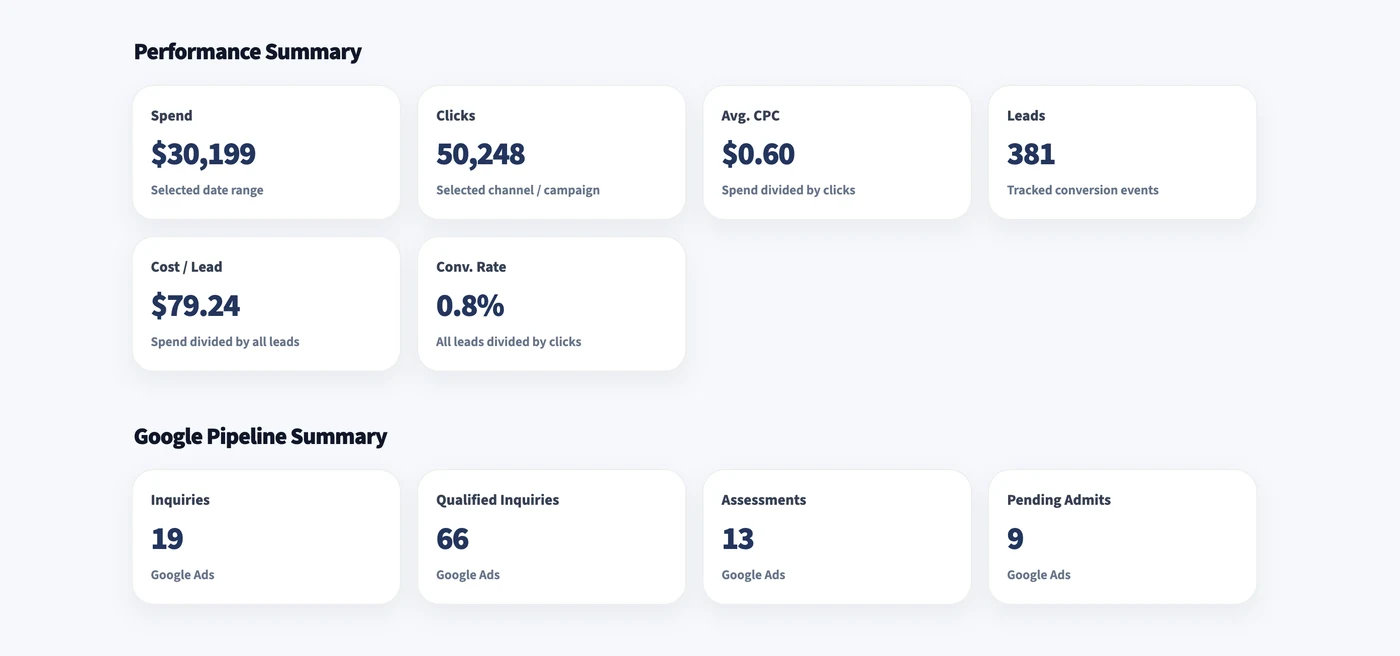
Every client gets a live dashboard at their own URL. No monthly PDF, no waiting for us to assemble something, no version where the agency gets to pick which numbers to show.
A real client dashboard. Metrics are tailored to each business.
If we run your campaigns, this gets built first, before a dollar of budget is spent. It's the bulk of what the one-time setup fee covers, and it's the reason our reporting looks different from the reports you're used to.
See how pricing works →You don't have to move your accounts to find out whether your numbers are real. We'll build the tracking and the dashboard around whatever you're running now, and hand you the keys. Plenty of people want to know the truth before they make any other decision, and that's a reasonable place to start.
Builds run $500 to $2,000 depending on complexity and how much of the chain has to be built from scratch. We quote it after one call, once we know what your systems look like.
Talk through a build →Yes, and we do. You keep your agency or your in-house team, we build the measurement layer around them, and everyone gets better information. If what it reveals eventually leads to a different conversation, that's your call to make with real numbers in front of you.
They usually do, on paper, and that's the point. When 138 reported leads turn out to be 62 real ones, nothing about your business changed. What changed is that you can now see it. Every decision you make after that is made on real information, and the first month is the uncomfortable one.
We've built this into HubSpot, Salesforce, HighLevel, Pipedrive, Workiz, ActiveCampaign, and Monday. If yours isn't on that list, it almost certainly still works: anything with an API can be connected, and the ones that give us trouble are the closed systems that won't let data in or out at all.
We treat this as a design constraint rather than a disclaimer. Neither Google nor Meta will sign a business associate agreement for their advertising products, so the working rule is that nothing capable of identifying a patient and their condition together ever reaches an ad platform.
In practice: server-side tracking so we control exactly what leaves your site, conversion events named for the action rather than the treatment, nothing tracked behind a patient login, and call tracking through a vendor that will sign a BAA. Your CRM holds the outcome and the revenue. The ad platforms get a signal that a conversion happened, not who it was or what they came in for.
We aren't attorneys and this isn't legal advice. What we give you is a written map of exactly what data moves where, so your counsel can review it and sign off before anything goes live.
Usually three to five days. What stretches it is a CRM that resists integration, or a website and forms that are awkward to work with, which is more common than you would think. If yours is going to be one of the slow ones, we will know early and tell you.
Access to your website, your ad accounts, and your CRM, and one person who can answer what a lead is worth and when it counts as a customer. That last one sounds small and it's the piece that decides whether any of this works.
Yes. The tag setup, the call tracking, and the CRM fields are all built in accounts you own. If you stop working with us, none of that turns off and none of it leaves with us. The dashboard is the one piece we host and maintain, so it ends when the engagement does, and we'll export your history before it does.
Book a free 30-minute call. We'll look at what you're tracking now and tell you what it's missing, even if you never hire us.
Book a Discovery Call